Latest Documents

CAHF & AUHF at FIC 2026: Blending Finance for Affordable Housing

The Centre for Affordable Housing Finance in Africa (CAHF) and African Union for Housing Finance will participate in the 4th International Forum on Living Environment

AUHF AFFORDABLE HOUSING AWARDS 2026

Transforming Africa’s Housing Future Recognising innovation, impact and collaboration The AUHF Affordable Housing Awards recognises outstanding projects, individuals, organisations and partnerships contributing to the advancement

Who we are

About CAHF

The Centre for Affordable Housing Finance in Africa (CAHF) has been operating as an independent think tank in South Africa since May 2014, pursuing its mission of making Africa’s housing finance markets work. CAHF’s work extends across the continent, and it is supported by and collaborates with a range of funders and partners.

CAHF acts as the
Secretariat of the AUHF

aufh

With 67 members from 23 countries, the AUHF is a member-based, industry association of mortgage banks, building societies, housing corporations, Development Finance Institutions and other organisations involved in the mobilisation of funds for shelter and housing on the African continent.

Our Work

Projects

CAHF Programme in Francophone Africa

CAHF’s Francophone Programme has been growing since 2016, supported originally by the French Development Agency (AFD) and more recently by the UN Habitat Office for the WAEMU Region.  Our efforts ...

Learn More

AUHF & CAHF Joint Events

Across Africa, governments, the private sector and DFIs are each grappling with how best to structure their investments in affordable housing, such that the construction of affordable housing is increased, ...
Learn More

Pipeline Deep Dive

CAHF is currently undertaking research in collaboration with SHOUT and Gmaurich Insights to understand the local economy and property market dynamics in the Pipeline Area

Learn More

AUHF Annual Conference & AGM

AUHF 42nd Annual Conference & AGM 2026   Hosted by the African Union for Housing Finance (AUHF), convened by its Secretariat, the Centre for Affordable Housing Finance in Africa (CAHF) ...

Learn More

Housing Finance Information Network (HOFINET)

The Centre for Affordable Housing Finance in Africa (CAHF) works with the Housing Finance Information Network (HOFINET) to consolidate, and make widely available, African housing finance information and knowledge. With HOFINET, we conduct ...
Learn More

Open Access Initiative

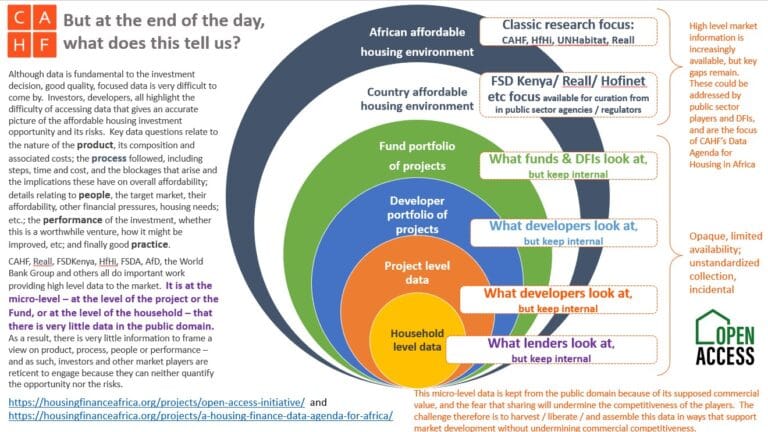
CAHF, along with other players – Reall, FSDKenya, FSDA, AfD, and others – have built a well-respected data and information base on affordable housing in Africa and, to a certain ...
Learn More

CAHF library

Dashboards

Nigeria Housing Data Dashboard

Using publicly available data from the Nigerian Bureau of Statistics, the Nigeria Housing Data Dashboard has been developed through the partnership between the Centre for Affordable Housing

Housing and Construction in Africa: 2010-2023

CAHF has been collecting data on house prices, construction costs, and income across Africa for the past thirteen years and publishing this in its Housing Finance

Housing Developments in the Nairobi Metropolitan Area

Kenya has an annual, estimated housing demand of 150,000 – 200,000 housing units, with an estimated housing supply of approximately 50,000 housing units annually. While

eThekwini residential properties: Focus on C3 Transit Corridor and Durban Central

The performance of the residential property market has a direct impact on municipalities—with respect to rates revenue, spatial integration, affordable housing and city planning. In

news & events

Discussions

Africa’s housing crises is not a lack of construction but a failure to recognize, formalize, and support endogenous housing production.

Kecia Rust, Executive Director and founder of the Centre for Affordable Housing Finance in Africa (CAHF), is featured in the seventh edition of African Cities

YIMBY Goes Global: What It Will Take to Build Africa’s Cities at Scale

As Africa prepares to welcome nearly a billion new urban residents over the next 25 years, a critical question emerges: can our cities keep up?