Countries
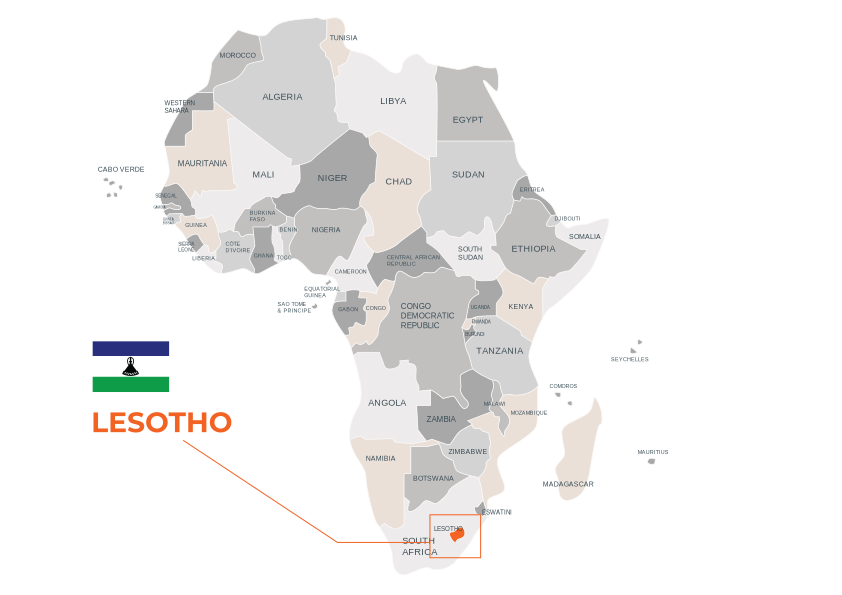
Lesotho
There have been several attempts to provide affordable housing in Lesotho, including attention to amending existing legislation. The Lesotho government has been working on policies to increase affordable housing availability and improve the delivery of services in low-cost housing areas. The legislative amendment seeks to improve land access and ownership rights to promote housing development. 1 Currently the legislation only acknowledges the existence of affordable housing (National Housing Policy 2018) without specifically expressing how it can be improved, thereby compromising the development of affordable housing in Lesotho. The proposed amendment aims to rectify this gap.
In addition, there is an increasing trend of collaboration between the Government of Lesotho and private developers such as Rise International to create affordable housing projects. There is also a focus on sustainability, whereby developers want to shift from imported building materials to locally sourced materials and environmentally-friendly construction methods.2 However, in terms of on-the-ground delivery, there has been little movement regarding affordable housing development since the low-cost housing project in Linakotseng by the Lesotho Housing and Land Development Corporation (LHLDC).3
It is estimated that over 70% of people in urban areas could have encroached into limited arable land by 2025. 25.5% of urban people live in slums
About 65.1% of households live off income from employment; 33.3% from their business or the sale of their produce or livestock; 5.7% from investments; 27.4% from social security, 35.5% from remittances, 19.6% from cash loans.
In 2021, the 2100 residential mortgages outstanding were valued at US$94 million. This put Lesotho’s mortgage to GDP ratio at 4.6%.
Housing Finance in Lesotho
More information
Find out more information on Lesotho’s housing finance sector, including key stakeholders, important policies and housing affordability:
Lesotho is a lower-middle-income country in South Africa with limited arable land that constitutes approximately 10% of the country’s rugged and mountainous terrain.4 The limited arable land has also led to conflicts regarding agriculture activities and housing development, intensifying land and housing shortages.5 The situation is critical in Maseru, which accommodates the largest share of the country’s urban population. Currently, the population of Lesotho is 2.3 million, and projections show that Maseru and its hinterland areas will accommodate approximately 550 000 people by 2030, thus increasing housing demand. At present, more than 60% of the population resides in rural areas.6 With an annual population growth rate of 1.1% in 2020,7 projections show that the population of Lesotho will be 2.5 million by 2030.
Lesotho had a nominal Gross Domestic Product (GDP) per capita of M16 199 (US$897.56) in 2023.8 Lesotho’s potential for development is impacted by the challenging global environment, which is characterised by the conflict in Ukraine, escalating global geopolitical tensions, climate change, and the waning COVID-19 epidemic. While real GDP contracted significantly during the COVID-19 pandemic in 2020, there has been some recovery in 2023 attributed mainly to the development of agriculture and mining. The GDP growth rate was 0.9% in 2023, and is expected to grow by 3.1% in 2024, and 3.3% in 2025, partly driven by the development of Lesotho Highlands Water Project II (LHWP-II).9 LHWP-II entails the building of a water transfer tunnel, the Senqu River bridge, and the Polihali dam.
Slow economy recovery is also evident from recent inflation rates. Having reached a high of approximately 8% in 2022, the annual inflation rate is expected to remain at 6.4% in 2024; then drop to 5.3% in 2025 and 4.9% in 2026.10 However, due to the delayed recovery, poverty levels have remained high in 2023 at 34.7%, based on M40.51 (US$2.24) per person per day in 2017 purchasing power parity [PPP] numbers. Such poverty levels have an enormous implication on housing financing, where most individuals need help to afford to buy land or housing through formal channels or to access loans and mortgages.11
The banking sector is the primary source of mortgage financing, while microfinance institutions exclusively offers personal loans. Standard Lesotho Bank, First National Bank, Nedbank, and Lesotho Post Bank are the four banks that offer these services.12 The Central Bank of Lesotho (CBL), the only regulatory body in the nation, oversees all financial institutions.
In 2023, CBL set the prime lending rate at 11.25%; it has remained unchanged in 2024. However, the interest rates various commercial banks charge for mortgage financing range from 11.55% to 13.5%. A 10% down payment on the loan is often required, and the remaining balance may be repaid over 20 years.13 Lesotho Post Bank’s repayment schedule may be up to 30 years, depending on several variables, including the borrower’s retirement age and the rate of the installment payments. In 2023 Standard Bank of Lesotho signed a memorandum of understanding (MOU) with the government and civil servants to provide favourable loan terms that accommodate civil servants.14 These terms include a more extended repayment period, a larger loan amount than that for which they are typically eligible, and flexible repayment options.
Lesotho’s annual urbanisation rate is 2.62%.15 It is estimated that over 70% of people in urban areas could have encroached into limited arable land by 2025.16 This underlines the need to capacitate the housing sector for planned serviced sites and expand the financial resources available to individuals to meet their projected housing needs.
Lesotho’s systemic housing and affordable finance limitations require clear and comprehensive remedies. The absence of affordable financing for home construction, renovations, and repairs, as well as the scarcity of sustainable housing options, restrict low-income families’ access to sufficient housing.17
Lesotho grapples with elevated rates of unemployment and poverty. In 2023, the unemployment rate stood at 16.5% based on a strict definition but expanded to38.3% when encompassing discouraged jobseekers.18 Approximately one-third of the population lives below the national poverty line of M31.18 (US$1.90) per person daily. Notably, the Gini Coefficient, a measure of income inequality, exhibited improvement from 0.55 in 2010 to 0.45 in 2017.19 The year 2019 saw informal employment constitute a significant portion of the total work force, comprising 80.85% of jobs, according to the ILO. Notably, men occupied a significantly higher proportion of informal employment at 66.9%, compared to women at 33.1%.
Most standard houses are usually built with simple materials and labour-intensive technologies. The average cost of a 50kg bag of cement in August 2024 wasM131.00 (US$7.26) and the average price of steel profiled roof sheeting was M245(US$13.57).20 On the minimum standard plot size of 375m2 in urban space, the most affordable two-roomed house with a pit latrine that one can build, inclusive of all costs, is M75 000 (US$4 155).21
The Standard Lesotho Bank collaborated with the Lesotho Housing and Land Development Corporation (LHLDC) on a project for low-cost housing at Linakotseng, Maseru, specifically for low-income earners. The prices were M95 000(US$5 263) for a single room, a two-room house for M110 000 (US$6 094), and three rooms for M295 000 (US$16 345).22 The LHLDC is a state-owned corporation that provides a comprehensive rental service for residential properties as a responsive strategy. However, given their income levels, this was well out of reach for most of Lesotho’s low-income earners.
The entry-level salaries for teachers are M11 587 (US$642) and M6 755(US$374), respectively, for members of the police force, and these salaries are before pay as you earn (PAYE) tax.23 This suggests that payments covering other household expenses, let alone mortgage payments, would be challenging. Nearly70% of households earn less than M1 000 (US$55) per month with a housing payment to income expenditure ratio of 4:1, leaving them to afford only a housing unit of approximately M48 000 (US$2 660).
In Lesotho, the distribution of household income is quite different. Approximately 65.1% of households earned income from employment, followed by 33.3% from business or the sale of their produce or livestock, 5.7% from investments, 27.4% from social security and other government assistance, 35.5% from remittances, and 19.6% from cash loans.24 Households were willing to pay between M700(US$38) and M2 000 (US$110) a month for a dwelling.25 This would imply the repayment of loans of M123 086 to M338 895 (US$6 820 to US$18 778),including a down payment of 20% and an interest rate of 12% over 20 years. However, the low-income population in the capital city can afford only M1 000(US$55) per month or an affordable loan amounting to M90 000 (US$4 987). These affordability levels translate into only a basic one-room housing unit for a household.
The majority of the country’s poor need help to afford the mortgage under writing standards. The loan repayment amount is typically far greater than the borrower’s net income. Hence, incremental construction and self-help housing are common in Maseru. In March 2024, the CBL indicated that there was already a total outstanding residential mortgage value of all banks in Lesotho of M435 million(US$24 million), marking a significant increase of M182 million (US$10 million)since June 2023. This change is evidence of the increasing rate of unemployment and poverty in Lesotho.26
Lesotho experiences a considerable housing backlog, exacerbated by obsolete housing stock in need of renovation, attributed to age and informal processes characterising the development processes on customary lands. It is estimated that 34 200 units are required to replace this obsolete housing stock, while 60 000 dwellings are needed to accommodate extra households by 2025. The National Housing Policy (NHP) projects that 98 711 houses are needed by 2025. However, considering the prevailing challenges listed above, this seems unachievable and would require substantial innovation to achieve the outlined projections.
Development is concentrated in specific areas; for example, the Maseru Planning Area and its hinterland continue absorbing much of the urban population under constrained conditions. By 2030, the population in this area will be projected to double to 550 000, and approximately 80 000 new housing units need to be constructed.27 This rapid urbanisation has thus resulted in overcrowding in informal rental housing. An estimated 169 706 rooms and 98 711 dwellings need to be built by 2025 to redress the urban housing deficit.28
There is no dedicated housing Ministry in Lesotho, and the Government of Lesotho supplies affordable housing through its state entity established in 1988, the LHLDC.29 The LHLDC achieves its objectives by developing serviced sites, providing rental accommodation, and encouraging homeownership. However, it has been challenging for the LHLDC to meet the housing needs in an urban space due to the reluctance and or inability of many Basotho to engage in any housing finance or commit to residential mortgages offered by any other financial institution. This reluctance or inability is attributed to low household incomes to afford mortgages. Affordable housing is usually provided through owner-financed incremental construction. Most of these developments happen on unplanned, limited arable land in urban areas with limited basic infrastructure and services.30 Another contributing factor has been the government’s reluctance to invest in affordable housing, thereby making it difficult for the LHLDC to sustain its supply of affordable housing.31
The other leading supplier of affordable housing in Lesotho since 2001 is Habitat for Humanity Lesotho, a non-governmental organisation. Habitat Lesotho builds two-room homes with safe sanitation facilities with vulnerable groups such as orphans, older adults and people with disabilities. In 2023, 51 new homes were completed.32
While there is limited housing, especially for the urban poor, women continue to experience inequalities and are disadvantaged in accessing land for housing.33 There are different typologies of houses supplied in Lesotho. Most housing is developed incrementally by the owners. Shortage of land leaves many individuals, especially in the urban areas, to resort to rental housing. There are rows of rental rooms locally referred to as “malaise”, the Sesotho word for “line”. Malaene are rectangular buildings, usually built using concrete blocks or local bricks and having a shallow roof of corrugated iron roof.34 Other urban dwellers rent in the polata, which refers to a rectangular building with three or fewer rooms and a shallow single-pitched roof.35
Lesotho has a dynamic land tenure system, primarily the statutory (leasehold) and customary systems. Land tenure rights have three types: leasehold, Form C, and Title Deed.36 The Land Administrative Authority (LAA) is the parastatal land agency with the authority to offer national cadaster, mapping, land administration, and the registration of land title deeds under the terms of the Land Act No. 8 of 2010.37 Landowners with leasehold rights can engage in various activities, including using the property as collateral for bank loans. By the end of 2023, LAA had a fully functional digital registration system that hastened the process.38 It takes 10 days for a leasehold to be issued at a flat rate, but for express services, which cost M1 500 (US$83.11), it takes less than 5 days for a lease to be issued.
The LAA charges a registration fee of M300 (US$16.62) for the deed of transfer and a consent fee on residential property of M100 (US$5.54). Other fees charged include stamp duty and transfer duty, which are based on the property’s market value.39 In 2023 alone, there was a total of 1 917 leases registered and a total of 100 809 registered properties since 1981.
Although Lesotho’s real estate industry is expanding quickly, the lack of legal regulation makes it challenging to control market pricing. Most Basotho cannot afford real estate, and prices are typically inflated. Increased land prices result in speculation in the market. A huge amount of outdated housing stock also needs renovation as it is built informally through incremental construction, thereby allowing urban sprawl.
The LHLDC provides a comprehensive rental service for residential properties as one strategy to address this problem. The properties offer a mixture of middle and high-income housing, mostly found at the core of Maseru city. The latest development consists of six apartment estates, with 42 two-bedroom apartments, with a monthly rent of M68 943 (US$382); 27 bachelor apartments, and ten single bed sitters with monthly rent of M5 371 (US$297) and M3 305 (US$183) respectively, for a total of 79 units.40
While the state should play a crucial role in housing delivery, in Lesotho, housing is relatively low in government structures with no dedicated ministry to address human settlement issues.41 LHLDC has led the small formal state supply. Private developers have difficulty building affordable units and typically operate in the high end market.42
For decades, the absence of a sustainable urban housing development framework in Lesotho has been primarily attributed to the lack of an operational national housing policy. The country’s first NHP was adopted in 2018, providing the vision of the Government of Lesotho for the development of adequate, affordable housing for people of all income groups in the country. However, the policy is yet to be accompanied by a Housing Act to enforce the provisions.43 The Principles of State Policy in the Constitution of Lesotho also provide that the state should fulfill several policy principles. Article 34 of the Constitution of Lesotho requires the state to adopt policies encouraging its citizens to acquire property, including land, houses, tools, and equipment, as far as economic conditions allow. Such principles, however, are not enforceable by the Constitution. Consequently, a direct and enforceable right to housing does not exist in Lesotho.45
Lesotho still practices customary land tenure, which discriminates against women by providing free property to married male members of a particular group. This was, therefore, corrected by the Legal Capacity of Married Persons Act No. 19 of 2022, which granted spouses married in a community of property equal rights and control over marital property. As a result, both spouses must obtain the consent of the other to get a loan, mortgage, or any type of financial credit. The revised act resolved the prejudice against women’s access to mortgages and land by eliminating all formally discriminatory customary restrictions.46 To promote secure land tenure, which is necessary for housing construction, the Land Act of 2010 oversees the regulation of land administration in Lesotho, including the rules relating to land acquisition, transfer, and use.47
The 2018 NHP remains a key legal framework governing urban land, property ownership and improved access to affordable housing, particularly for low-income households. The Policy promotes sustainable housing development, provides financial assistance for housing, and advocates for housing security and tenure rights. The Town and Country Planning Act of 1980 outlines the regulation and proper use of land. As old as this legislation is, it is still used as a guiding tool to promote the orderly development of land and regulate the changes that take place.48 Planning Standards were established by Swedish consultants for Lesotho as a regulatory framework of planning, and minimum standards were set out, including a mandated minimum plot size for residential use of 375m2 to accommodate urban farming.
Investment opportunities in residential property in Lesotho, particularly in urban areas such as Maseru and Teyateyaneng, are available. There is a great need to support incremental housing strategies and remove barriers to mortgage underwriting – exploring alternative options for informal employment documentation, addressing high down payments, and improving financial literacy.
Due to banks’ high mortgage underwriting standards, many households look to the microfinance sector to support their access to affordable housing. Finance institutions can offer loans with more lenient repayment terms and affordable interest rates exclusively for the low-income population. Therefore, investigating small-scale lending and microloan options is also essential in order to increase the number of people who can obtain financing to construct their homes.
Steps being taken by the government to improve the policy and legislative framework for affordable housing are also important. By implementing policy measures to address the scarcity of affordable housing, the government can act as a catalyst for growth and opportunity for both investors and developers in the housing sector. Finally, another opportunity is public-private collaboration to expand access to affordable housing
Access to housing finance data in Lesotho is especially challenging, with very little information available to the public. The Lesotho Bureau of Statistics, the Central Bank of Lesotho, the four commercial banks (Nedbank Lesotho, Standard Lesotho Bank, First National Bank Lesotho, and the Lesotho Post Bank), the Lesotho Housing and Land Development Corporation, and the Land Administration Authority are the primary sources of information on housing finance. However, there is no institution that specifically collects housing finance data in Lesotho, thereby making it difficult to find such data. The information found in secondary sources is frequently either out-of-date or presented in an unusable manner. Gender-disaggregated data is very scarce.49
Rise International, a non-profit social enterprise registered in the US and Lesotho, has made tremendous progress with sandbag technology and compressed earth blocks to create novel construction methods for affordable housing. The organisation has recently entered into a partnership with the housing ministry of the Government of Lesotho to kick start innovative way of building affordable houses in Lesotho.
Rise International has successfully built two houses as a test project, one using sandbag technology and the other using international compressed earth blocks. Both innovations appear cost-effective compared to the use of imported materials. In addition to lowering construction costs, Rise International lessens the environmental impact of traditional construction methods by using locally available resources. Sandbags give flexibility and insulating qualities, while compressed earth blocks are a sturdy and environmentally-friendly substitute for conventional bricks.
By generating employment possibilities in the construction industry, this strategy empowers local populations economically and encourages sustainable practices which respect the region’s distinct ecological context. This development will focus on people who cannot afford to buy or build houses and those that do not qualify for loans to build houses. Using these endeavours, Rise International is enhancing the housing landscape in Lesotho by rendering it more ecologically sustainable and attainable, thus enhancing the standard of living for numerous households.
For more information, see: https://riseint.org/
Central Bank of Lesotho: www.centralbank.org.ls
Habitat for Humanity Lesotho: https://habitat.org.ls/
Land Administration Authority: www.laa.org.ls
Lesotho Bureau of Statistics: www.bos.gv.ls
Lesotho Housing and Land Development Corporation: www.lesothohousing.org.ls
- Interview with Motseoa Koaleli, Housing officer, Ministry of Local Government and Chieftainship. 15 July 2024.
- Interview with Minah Lekau, Program Officer, Rise International Lesotho. 20 July 2024.
- Interview with Kananelo Kota, Property portfolio manager, Lesotho Housing and Land Development Corporation (LHLDC). 21 August 2024.
- Leduka, R., et al (2015).The State of Poverty and Food Insecurity in Maseru, Lesotho (rep., pp. i-80). Kingston, ON and Cape Town: African Food Security Urban Network. Urban Food Security Series No. 21. Pg. 11.
- De Stage R, Johnson S. (2021). Lesotho – Context and land governance.
- World Bank (2023).The World Bank Group Country Partnership Framework FY24-28 for the Kingdom of Lesotho (English).Washington, D. C:World Bank Group.
- World Bank (2022). Population growth (annual %).World Bank Data.
https://data.worldbank.org/indicator/SP.POP.GROW?locations/LS (Accessed 25 September 2023). - World Bank (2024). Lesotho. World Bank Data. https://data.worldbank.org/country/LS (Accessed 22 August 2024).
- World Bank (2023). Sub-Saharan Africa: Macro Poverty Outlook. Country-by-country analysis and projections for the developing world.Washington, D.C:The World Bank Group. Pg. 49.
- Central Bank of Lesotho (2024). Lesotho Economic Outlook, 2024-2025. Maseru: Central Bank of Lesotho.
- Thebe,V, Rakotje, M.F. (2013). Land strategies and livelihood dynamics in peri-urban communities: Challenges to land and agricultural policy in Lesotho. African Studies, 72(3): 399-415.
- Interview with RefiloeTshephe, Macroprudentil Policy & Analysis, Central Bank of Lesotho. 21 August 2023.
- Interview with Mahali Khalema, Home Loan Support and Project Development, Standard Lesotho Bank. 20 August 2023.
- Mphutlane,T. (2018). Bank launches loan scheme for civil servants.The Post. 23 February 2023.
- World Bank Data (2023). Urban population growth (annual %).World Bank Data.
- World Bank. 2023.The World Bank Group Country Partnership Framework FY24-28 for the Kingdom of Lesotho (English).Washington, D. C:World Bank Group.
- UN-Habitat (2023). Policy options to meet the 2018 national housing policy objectives of Lesotho. UN-Habitat: Nairobi https://unhabitat.org/sites/default/files/2023/03/lesotho_national_housing_policy_options_report_final.pdf. (Accessed 27 September 2023).
- World Bank (2024). Unemployment rate in Lesotho. World Bank data.
https://data.worldbank.org/indicator/SL.UEM.TOTL.ZS (Accessed 22 August 2024). - 2017 is the most recent data for Lesotho. Trading Economics (2021). Gini Index Lesotho. https://tradingeconomics.com/lesotho/gini-index-wb-data.html (Accessed 25 July 2023).
- Interview with Theko Tsekoa, Building Supervisor, Habitat for Humanity Lesotho, 8 August 2024, Maseru, Lesotho.
- Ibid.
- Interview with Mahali Khalema, Home Loan Support and Project Development, Standard Lesotho Bank. 8 August 2024.
- Government of Lesotho (2023). Salary structure. Ministry of the Public Service Circular Notice No. 10. Government Printers.
- Bureau of Statistics (2021). Lesotho 2017/18: Continuous Multipurpose Survey/Household Budget Survey. Bureau of Statistics. Statistical Survey Report.
- Ibid.
- Data supplied by the Central Bank of Lesotho. 2024.
- Kingdom of Lesotho (2023). National Strategic Development Plan II: Strategic Focus 2023/24-2027/28. Government of Lesotho: Maseru.
- UN-Habitat (2015). Lesotho Housing Profile. Nairobi: UN-HABITAT. Lesotho Urban Housing Profile | UN-Habitat. Pg. 5. https://unhabitat.org/lesotho-urban-housing-profile (Accessed 15 July 2023).
- Ibid.
- Leduka, R. C. (2012). Lesotho urban land market scoping study. Urban Landmark: Pretoria.
- See footnote 28.
- See https://www.habitat.org/where-we-build/lesotho
- Paradza, G. (2018).Women’s access to land and housing in Lesotho. https://landportal.org/nl/node/81338 (Accessed 22 September 2023).
- See footnote 28. Pg. 28.
- Ibid.
- Leduka, R., Ntaote, M. and Takalimane, N. 2019. Land governance in Lesotho. In Land Governance in Southern Africa Symposium.
- Land Administration Authority (LAA). Lesotho Laws. https://www.laa.org.ls/laws/ (Accessed 18 August 2023).
- Interview with Keneuoe Ntsau Molapo, Billing andValuations Service Manager, Land Administration Authority, 30 July 2024, Maseru, Lesotho.
- Ibid.
- Interview with Kananelo Kota, Property Portfolio Manager, Lesotho Housing, 30 July 2024, Maseru, Lesotho.
- See footnote 28.
- Ibid.
- The Government of Lesotho (2018). National Strategic Development Plan II 2018/19-2022/23. In Pursuit of Economic and Institutional Transformation for Private Sector-led Jobs and Inclusive Growth.
- The Government of Lesotho (1993).The Constitution of Lesotho. Morija: Government Printers.
- See footnote 28. Pg. 13.
- The Government of Lesotho (2022). Legal Capacity of Married Persons Act No. 19 of 2022. Morija: Government Printers.
- The Government of Lesotho. (2010). Land Act 20210. Morija: Government Printers.
- The Government of Lesotho (1980).Town and Country Planning Act No 11 of 1980. Morija: Government Printers.
- Interview with Mahali Khalema, Home Loan Support and Project Development, Standard Lesotho Bank. 20 August 2023.
image submissions
CAHF welcomes image submissions that are relevant to affordable housing in Africa. Send your photos to [email protected] for possible inclusion on our website.
media gallery
View image gallery of photos for other countries